


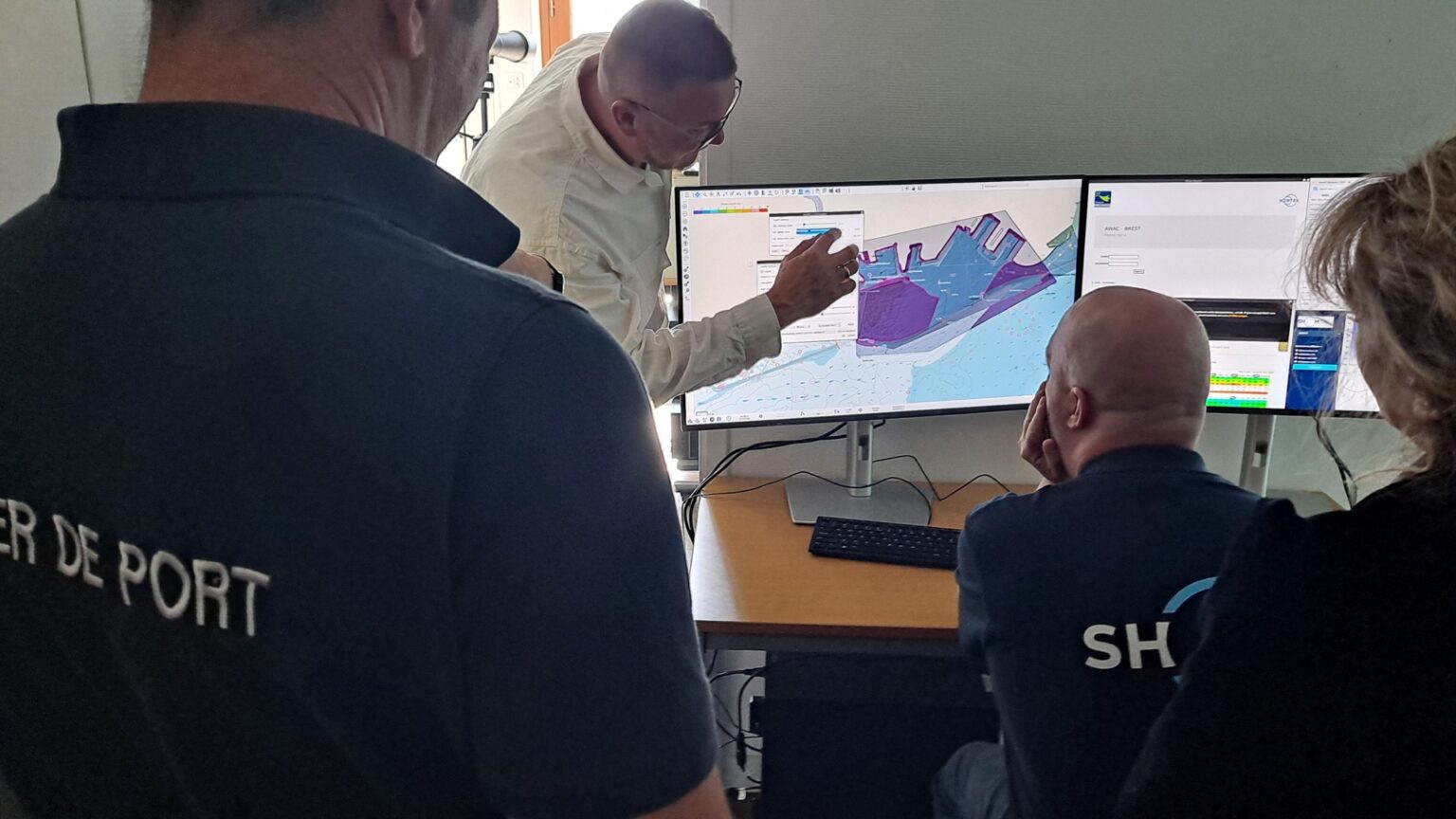
Between 21 and 23 April 2026, BrestPort hosted the first real-world demonstration of the system developed as part of the European Overheat project. This pilot project marks an important step toward safer and more efficient maritime traffic management thanks to the new digital standards of e-navigation.
BrestPort, a pilot site for the European Overheat project
Since January 2024, BrestPort has been participating in the European Overheat project, funded by the Horizon 2020 program. This initiative brings together several partners around a common goal: to develop digital tools capable of improving maritime safety at sea and, more generally, the management of port operations.
In this context, the Port of Brest is serving as a trial site. It is gradually being equipped with new terminals for the harbor master’s office, maritime pilots, and various port operators.
A first full-scale demonstration
From April 21 to 23, the teams installed prototype VTS, ECDIS, and PPU terminals at the Harbor Master’s Office to test the system under operational conditions.
The scenario involved a simulated fire aboard a container ship. Various digital tools made it possible to share relevant information in real time among those involved in managing the event.
Features tested in real time
The tests allowed us to evaluate several innovative features. The system uses the S-100 standard defined by the IMO for new generations of maritime terminals and data. The demonstration provided a visual representation of the integration of traditional data (port map (S-101), bathymetry (S-102), and vessel AIS) and dynamic data (tides (S-104), surface currents (S-111), and video feeds from cameras).
Thanks to these innovations, navigable areas are displayed in near real time on VTS, ECDIS, and PPU terminals, with bathymetric and tidal data overlaid directly on the navigation chart.
A collaborative project supporting maritime operators
The Overheat project is based on collaboration among several European partners with complementary expertise. SeaTopic is coordinating the development of the digital system, while Innovative Navigation and SHOM are responsible for developing the S-100 prototypes. ENSM is providing its navigation simulation platform, CIRCOE is leading the testing and demonstration phases, and Topview and PeopleTrust are contributing their expertise in fire detection and drone surveillance.
As a pioneering French site, BrestPort is involving the harbor master’s office, maritime pilots, and its operations and management teams in these trials.
Tangible benefits for navigation
By enabling all operators to share a common view of the maritime situation, these new tools help improve risk analysis, strengthen coordination among the various stakeholders, and optimize port call preparations through more accurate estimates of vessel arrival times.
The recording and playback features also offer new possibilities for incident analysis and lessons learned, all in the interest of maritime safety.
A new milestone in September 2026
The installation of the final version of the prototype is scheduled for 15 to 17 September 2026.
To mark the occasion, BrestPort and its partners will host an open house on September 17 for professionals in the maritime sector to demonstrate how the system works and present the results of the trials. Save the date!